Using Data to Improve Education While Protecting Student Privacy
- alehmaldonado09
- Apr 1
- 3 min read
Key Insights
1. The Importance of Common Data Definitions
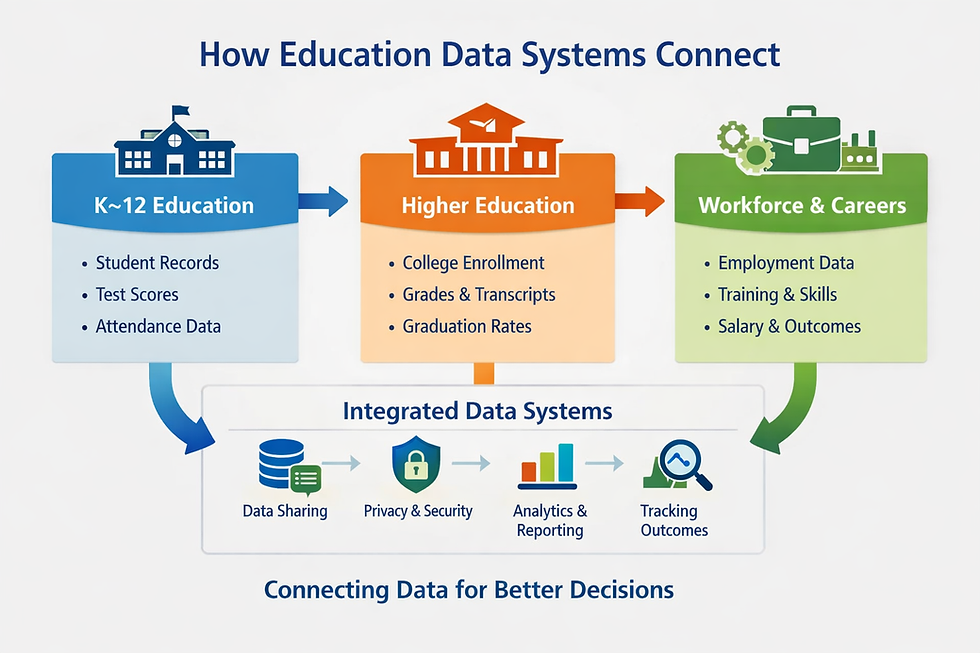
One key idea is the importance of using common data definitions across education systems. Schools, universities, and workforce agencies collect large amounts of data about students, but they often define important terms differently. For example, the definition of a first-generation college student may vary depending on the institution (U.S. Department of Education, n.d.).
When definitions are inconsistent, it becomes difficult to compare or combine data across systems. Establishing common data standards allows institutions to share information more effectively and analyze trends that can improve student achievement. Standardized data also helps policymakers and educators make informed decisions that support student success (SREB, 2016; U.S. Department of Education, n.d.).
2. The Growing Role of Big Data in Education
Another important concept is the increasing use of big data to improve teaching and learning outcomes. Educational data systems collect information from learning management systems, student information systems, and other digital platforms. These large datasets can help educators identify patterns in student performance and engagement (Fischer et al., 2020).
For example, data analysis can help predict which students may be at risk academically and allow institutions to provide early support. Big data can also help researchers evaluate teaching methods and design tools that improve learning outcomes. However, analyzing big data requires advanced technical skills and careful interpretation to avoid misleading conclusions (Fischer et al., 2020).

3. The Importance of Data Privacy and Security
It is also critical to protect student data privacy and maintain secure data systems. Schools and colleges store sensitive information such as academic records, personal details, and financial information. Because of this, educational institutions must implement strong security measures to prevent unauthorized access or data breaches (SREB, 2016).
Federal laws such as the Family Educational Rights and Privacy Act (FERPA) help protect student information by giving individuals rights over how their education records are shared (U.S. Department of Education, n.d.). At the same time, schools must balance privacy protection with the need to use data for research and decision-making that improves education (SREB, 2016).

Importance to My Professional and Learning Experience
As someone working in higher education and student support, understanding how data systems work is very important. Universities rely heavily on data to track enrollment, monitor student progress, and evaluate academic programs.
For example, academic advisors often use student data to identify students who may need additional support. By analyzing academic performance and course completion patterns, institutions can intervene early and help students stay on track to graduate (Fischer et al., 2020). However, this information must be handled responsibly to maintain student trust and ensure compliance with privacy laws (SREB, 2016).

Areas I Need to Learn More About
Although I understand the importance of educational data systems, I would like to learn more about data analytics tools used in higher education. Many institutions are beginning to use predictive analytics to improve student retention and graduation rates (Fischer et al., 2020).
Learning more about these tools would help me better understand how institutions analyze student data and make data-driven decisions. It would also help me interpret reports and research findings more effectively in my professional role.
Resource for Future Reference
A valuable resource for learning more about education data systems is the work of the Data Quality Campaign (DQC), which provides research and guidance on using data responsibly to improve student outcomes (DQC, n.d.).
Resource:https://dataqualitycampaign.org
References
Data Quality Campaign. (n.d.). Using data to improve student outcomes. https://dataqualitycampaign.org
Fischer, C., Pardos, Z., Baker, R., Williams, J., Smyth, P., Yu, R., Slater, S., Baker, R., & Warschauer, M. (2020). Big data in education. Review of Research in Education, 44, 130–160. https://doi.org/10.3102/0091732X20903300
U.S. Department of Education. (n.d.). Common Education Data Standards (CEDS). https://ceds.ed.gov
U.S. Department of Education. (n.d.). Family Educational Rights and Privacy Act (FERPA). https://www2.ed.gov/policy/gen/guid/fpco/ferpa


Ms. Maldonado,
Thank you for enlightening me with this powerful information. Your blog was easy to follow and your perspective was clear. You did a wonderful job explaining how using data can improve education while we still keeping student privacy in mind. The balance between showing the benefits of data use and also the concerns that come with it.
What stood out was how you explained the importance of protecting student information. That is such a big issue right now, especially with so much technology being used in classrooms. The research has already shown us that while data can help personalize learning and improve outcomes for students, there are still real concerns about how the data is collected and shared…